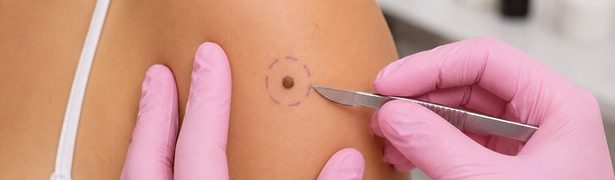
Surgical treatment of moles and scars
We surgically remove high-risk or bothersome moles and revise older and more extensive scars. Removed moles are sent for histological examination, and scars can be refined after revision with a vascular laser.
Who is the treatment suitable for?
Surgical treatment is suitable for patients whose doctor recommended removal of a high-risk or suspicious mole during a mole check, and also for those who find a mole bothersome – for example, it catches on clothing or they consider it aesthetically distracting. The second group comprises people with older, larger or unsightly scars from surgery or injuries for whom laser treatment alone is not enough. The doctor always decides whether the procedure is suitable at a personal consultation.
What surgical treatment involves
For moles, this means excision – cutting out the mole with a small margin of surrounding healthy skin and then stitching the wound. The removed tissue is sent for histological examination, which determines the nature of the mole. For scars, the surgeon abrades or excises the scar and carefully re-sutures it so that the new scar is narrower and less noticeable. The result for scars can then be refined with a vascular laser. Older scars usually improve less markedly than fresh ones.
What does it address?
- High-risk moles
- Bothersome moles
- Older extensive scars
- Unsightly scars
How the procedure works
Minor skin surgery is usually performed on an outpatient basis under local anaesthesia, so you remain conscious throughout and feel no pain. The doctor disinfects and numbs the treated area, then removes the mole or scar and closes the wound with stitches. Wherever possible, the incision follows the natural skin lines so that it heals as well as possible. The length of the procedure depends on the size and location of the treated area, and the doctor will specify it at the consultation.
Surgical treatment follows on from mole examination with a digital microcamera and complements laser scar treatment. This allows the doctor to choose a combination of methods for each patient that suits the nature, age and location of the skin finding.
Course of the treatment
The procedure is preceded by a consultation with the doctor, who will assess the mole or scar and explain the treatment options and the expected result. For moles, it usually follows on from a digital examination. On the day of the procedure, the area is numbed with local anaesthetic, then the removal and wound closure are carried out. After the procedure, you will receive wound care instructions and an appointment for a check-up or suture removal. The doctor will discuss the histology result with you and recommend further steps accordingly.
Aftercare
The wound must be kept clean and protected as instructed by the doctor; non-absorbable stitches are removed at the check-up. Protect the healing scar from the sun and use a cream with a UV filter. The doctor may recommend healing ointments and scar massage to help soften it. For scar revision, laser treatment can follow once the wound has healed. If the doctor recommends regular mole checks, it is wise to keep to them.
Benefits of the treatment
- Histological verification of the removed mole
- Outpatient, under local anaesthesia
- Follows on from digital mole examination
- Scar can be refined with a vascular laser
FAQ
Why is the mole sent for histology?
Histological examination under a microscope determines the nature of the removed mole. Based on the result, the doctor will advise whether further monitoring or treatment is needed.
Is the procedure painful?
The procedure is performed under local anaesthesia, so you will not feel pain during it. Once the anaesthetic wears off, there may be mild tenderness at the wound site.
Will there be a scar after mole removal?
Surgical removal leaves a small scar. The doctor places the incision so that it heals as well as possible, and the scar can later be softened with a laser if needed.
When to choose surgery and when laser for scars?
Fresh red scars respond well to a vascular laser. Older and larger scars are often best revised surgically by abrasion or re-suturing and then refined with a laser.
How much does the procedure cost?
The price depends on the size, number and location of the moles or scars. The doctor will set the exact amount at your consultation.
ASK OUR ADVICE
Not sure which treatment is right for you?
We will be happy to help you choose and recommend the most suitable solution for your needs.
laserplastic@laserplastic.cz 724 860 082